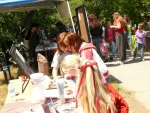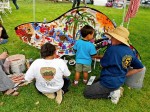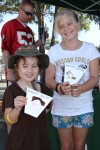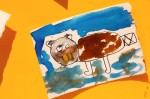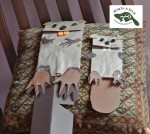



I can’t think of any crowd of people more likely to appreciate this shirt than the attendees at out own beaver festival. Trailkeepers generous donation may have created a dangerous Christmas sale at the mall stampede moment.

I can’t think of any crowd of people more likely to appreciate this shirt than the attendees at out own beaver festival. Trailkeepers generous donation may have created a dangerous Christmas sale at the mall stampede moment.
I recently came across this book published last year in Scotland, part of the Kelpies children series. Written by Catherine Ward and illustrated by Phoebe Roze. I have fall in love with these dreamy floaty images. Since I tend to keep an eye out for beaver illustrations I was surprised it escaped my attention, but when I shared it on the Beaver Facebook Forum it created such a splash I realized no one there had seen it either.
This book needs to be seen!
One thing I especially appreciated was that the beaver faces indicate these are castor fiber. They have a shorter snout and a snubier nose that might be overlooked by anyone who hasn’t spent hours watching castor canadensis. I especially adored this image:
It made me remember those rare moments in the summertime of your youth when all your family is in the pool together. Dad with his skinny legs and mom fussing about her hair and your siblings trying to show off some new trick they just invented.
Being a beaver must be a lot of fun.
Obviously the little girl in the story thought so too, because here she is imagining what the inside of her beaver lodge would look like:
I wrote about beavers as Kelpies 13 years ago on this very website when talking with one our Scotish beaver buddies.
“Stone carvings of this mysterious ‘pictish beast’ are seen all over Scotland. It has been described as like a seahorse, or a dinosaur. In most tales the Kelpie is noted to be very black, very at home in the water, but breathing air. Usually only its eyes are seen above the surface of the water, it’s very strong and its mane is constantly dripping. It’s fur is smooth like a seals but it is deathly cold to the touch”
Kelpies publications are a series of Scotish books made for children everywhere.
Rusty from Napa found this video of the author reading her story. I especially love how the real transition of moving to a new home which is so hard for children is paralleled by the beavers new housekeeping. Clever to find something almost every child feels with something so few children know about.
You can pick up your own copy here:
or on amazon where I got mine. I wrote the publishers yesterday to try and talk them into donating a copy or two for the festival, I’ll let you know if that works.
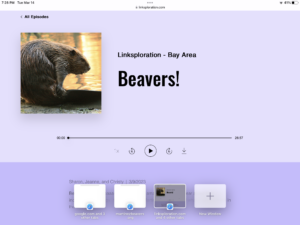
This timely report from Boston tickled all my fancies. Here’s a young girl using advanced technology to communicate with beavers and listening to the elders teaching at the same time.
Beavers are powerful architects of the land that bring innumerable benefits to the land and the people living there. They can make rivers run backwards, create fish habitat, mitigate wildfires, among other things. Indigenous people know this, but colonizers have disrupted the relationship between beaver and human. One researcher hopes to repair the relationship now… through robots.
Jordan Kennedy is a beaver expert and a former engineering post-doc at the Harvard Graduate School of Design, now working at the Woods Hole Oceanographic Institute. She’s also a member of the Blackfeet Nation. As a part of her research at Harvard, she worked with a robotics team to create a robot beaver, affectionately called Beaverbot 2.
Truly. How fricken cool is that? A Blackfoot Harvard Grad with a passion for beavers. R Grace Morgan would be so proud.
The beaverbot is programmed to make decisions about where to go in the same way as a real foraging beaver might. Kennedy hopes once the beaver is finished, they can use it on a research site.
“We’re trying to reimagine these landscapes as if beavers had been deployed on them in order to figure out a way to make it hold more water on the landscape,” Kennedy said.
Beavers are incredible ecosystem engineers. Their works make rivers run backwards, create fish habitat, mitigate wildfires, and many more things. But in the past few centuries, American settlers hunted beavers and destroyed their habitat, driving them out of the lands they used to build on.
Listen to the entire program. It’s very wonderful to imagine a native graduate trying to use robots to teach beavers to do what they never forgot. And to teach people to let them.
(I’m very low tech and wonder if it might not be better to plant some willow and stand back and watch.)
These murals by Aysha McConkey in British Columbia knock me out. It’s a whole floor of over/under scenes at the Blue Heron Nature Preserve at Fraser University.; Aren’t they amazing?

There’s just one thing I think its missing…I’m sure you saw it to.